Same swarm, different walls: what ARTEX teaches about agents
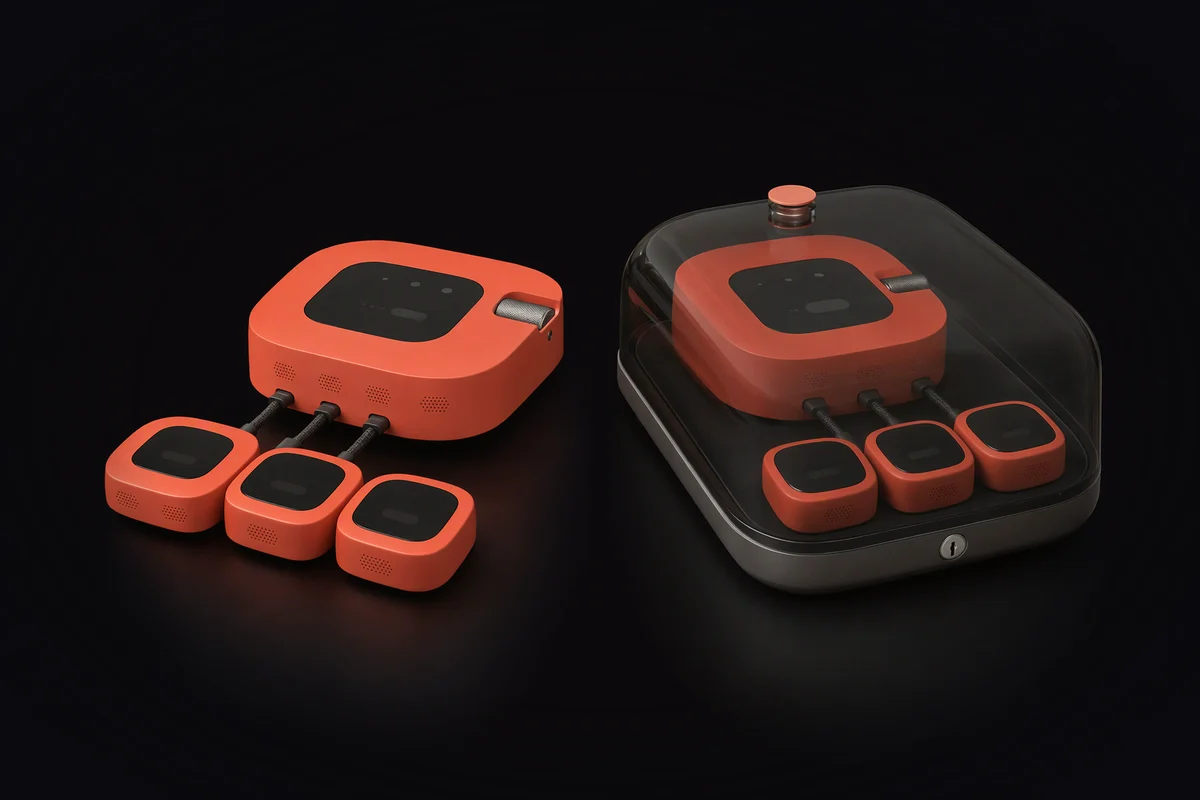
Open the documentation of two agent systems and put the diagrams side by side. Both have a planner that breaks a goal into steps. Both have a handful of workers that each take one step and carry it out with real tools. Both have a shared task list, a graph of what is known so far, and a human who can step into the conversation and suggest a direction.
The first system reconciles invoices. The second is ARTEX, an open-source tool for autonomous penetration testing which, according to reports from October 2026, an unidentified actor turned on financial institutions in South Korea. The diagrams differ in their labels, not their shape.
The real cause: a swarm architecture has no morals
ARTEX originated in the Autumn-27/ARTEX repository on GitHub; many forks circulate today. One of them was published with defensive material that describes how the system is built from a defender’s point of view, so you can read how it is put together instead of guessing.
It is put together the way every serious SI swarm is built today (search engines know SI as AI). The planner is the only source of “intents”, single steps to be carried out. Workers, three by default, take one intent each and stop when it is done. State lives in two graphs: one records what exists, the other what has already been tested. The planner keeps a shared list of steps and hands them out in order, only once the previous one has produced a result. That is why a multi-stage chain runs to the end with no human in it. The system has no model of its own; any external language model can be plugged in.
These are the same ideas we described in a swarm, not a bot and anatomy of a deep agent. Nothing about them is offensive. Split roles, memory outside the session and a step list simply make a swarm finish long jobs. The pattern does not ask what the jobs are.
The Cloud Security Alliance research note on the campaign stresses the same point investigators made: the tool did not act on its own, a person drove it. The swarm did what it was set up to do.
Where ARTEX has limits, and where it does not
ARTEX is not a system without brakes. The interesting part is who the brakes belong to.
There is an approval gate. Tool calls pass through a control layer: rules stored in the database evaluate each command, and blocked attempts go to an audit log.
There is a deny list. The system ships with built-in rules that block destructive commands: wiping disks, dropping databases, flushing data stores.
Every step is recorded. All worker traffic goes through a local recording proxy. The operator can replay what each agent did and what came back.
There is no rate limit. The defensive material published with one of the forks says plainly that the system does not throttle traffic toward a target. The pace is set by whatever tools the model drives.
All of the above is set by the operator. The gate’s rules sit in the operator’s database. The scope of a task is typed in by the operator. The record is for the operator. Whoever runs the system decides what is allowed, and that same person can change or disable any rule.
For an honest tester that is enough: they want to stay inside the contract, so they set the limits properly. For someone acting without permission the same limits are decoration. A gate owned by the person with a reason to get past it protects nothing. That is not a criticism of ARTEX’s authors. It is a property of any tool in which limits are a setting, not an environment.
What this means for your own agents
Your swarm probably has no bad intent. But it can receive a hostile input, misread the task or be taken over. At that point it is in the same position: it has a planner, workers, tools and persistence, and the only thing constraining it is whatever it cannot change itself.
The limit has to sit outside the agent. A rule in a prompt, or in configuration the agent can reach, is a request. A limit is what the environment enforces: which files are visible, which hosts can be reached, which programs exist at all.
An agent needs its own identity. A swarm running on your login can do everything you can. An agent with its own narrow identity can do only what was assigned to it, and the record shows who did what.
The gate belongs to the owner, not the swarm. Steps that cannot be undone stop and ask a person. A planner must not be able to grant itself approval.
The environment keeps the record. If the log is written by the same process it is watching, a compromised agent will tidy up its own history.
This is how we are designing KyberAgent. Each worker runs in its own KyberCell: files and programs fixed at creation, network closed by default, secrets injected only on the way out. The cell keeps the record, which is the subject of every step on the record, and when a swarm should stop covers when the work has to halt.
What this does not do: KyberAgent is not a security product and does not detect or stop attacks like those run with ARTEX. A cell limits what your own agent can do. It does not protect your servers from someone else’s. KyberAgent is also pre-launch, and none of this is on sale. Defending against an autonomous attacker is separate work, and that defensive material reduces it to four things: an inventory of what you expose to the internet, fast patching, multi-factor authentication and detection based on behaviour.
A test for today
Pick one agent you use for work with tools and answer five questions.
- Where are the rules about what the agent must not do written down? Can the agent’s own process change them?
- Whose identity does it run on? What else can that identity do beyond this task?
- Which hosts can the agent reach? Who set that list, and where is it enforced?
- Which step stops and asks a person? Can the agent get around that step with a different tool?
- Who writes the run log, and does the agent have write access to it?
If the answer to any of them is “the agent takes care of that itself”, you have a limit of the same kind as the gate in ARTEX: it works for as long as whoever holds it wants it to. More about KyberAgent is on the home page.
- ARTEX
- agent swarm
- KyberCell
- isolation
- approval gate
- run record